



AI in Financial Compliance and Controlling: Key Takeaways from Our Latest Webinar
Artificial intelligence (AI) is reshaping financial compliance and controlling faster than many expected. During our recent webinar, AI in Financial Compliance & Controlling, we asked finance, risk and compliance professionals how AI will influence their work. Their answers, combined with insights from Mads Bjørkmann and Lasse Rindom from Basico, revealed a clear truth: AI is here, accessible, and already changing how teams operate.
This blog summarizes the most important discussions, polls and practical guidance shared during the session, enriched with real examples from practitioners who work with AI in CFO services every day.
1. AI Adoption Is Accelerating — Even in Conservative Functions
Finance and compliance teams are naturally cautious. Accuracy and confidence in numbers matter. Earlier this year, 20 percent of Impero customers said they did not want AI in the platform. A few months later, that number dropped to 8 percent.
This underscores a major shift. AI is no longer something that just “commercial teams experiment with.” It is becoming a practical, expected tool for finance and controlling.
Why the early resistance?
- Finance and controlling teams are responsible for accuracy, completeness and governance.
- They are used to working with high certainty.
- New technology introduces risk, and risk slows down adoption.
But the mindset is changing fast with the company-wide introduction of AI tools, like Copilot, Claude or Gemini. AI is now accessible enough that experimentation feels safe and manageable, and the value is becoming too great to ignore.
2. Teams Expect Simplicity, but AI Also Introduces Complexity
When asked how AI will impact their job, 67 percent of participants said they expect fewer manual tasks and more analytical work.
But that is only part of the picture.
Lasse Rindom explained that AI may not reduce overall workload. Instead, it increases output. Teams can do more, go deeper and provide more value. But this also introduces new forms of complexity.
The key question teams must ask is: Are we optimizing for speed, quality, or volume?
Your AI strategy depends on what outcome you want. And determining your desired outcome of using AI is key to ensuring that you effectively adopt it (more on that in point 5).
3. Finance Teams Spend Too Much Time Creating Data
Finance, tax and compliance functions spend a disproportionate amount of time creating, structuring and cleansing data instead of analyzing it.
AI changes this dynamic.
It is excellent at sorting through unstructured data (master data), identifying patterns and providing structure where none exists.
Mads Bjørkmann put it clearly:
AI should not be used as a small-time personal assistant. It should help teams do what matters — validate, review, interpret and advise the business.
4. The AI Skill Tree: Most Teams Still Operate in Levels 1–3
Most webinar participants identified their team at Level 1, 2, or 3 maturity. These stages involve:
- Manual processes
- Early automation
- Experimentation
- Heavy spreadsheet and file-based workflows
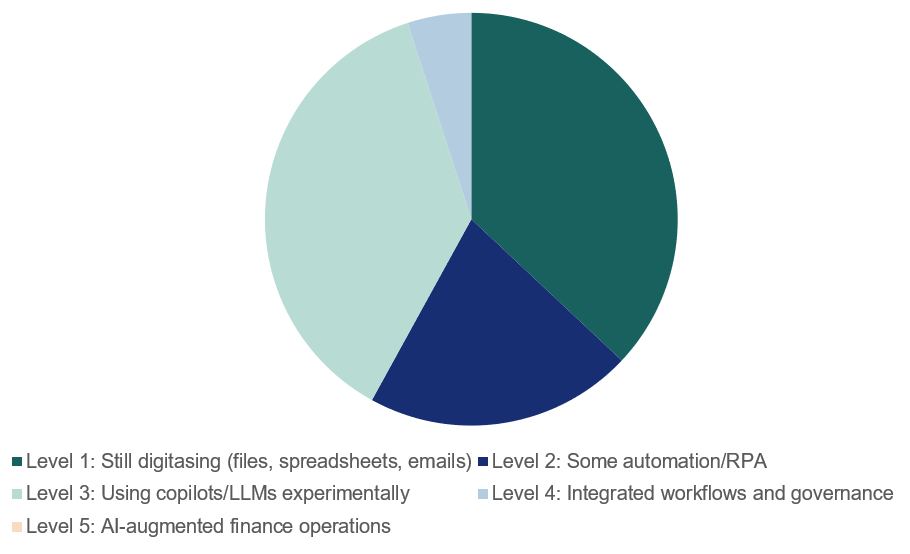
Very few organizations reach Level 4 or 5, where AI-driven insight and automation work seamlessly with human review.
Importantly, you cannot jump ahead.
Even at higher maturity levels, Levels 1–3 remain the foundation. Teams need the building blocks to move upward, and consistency over time is key.
5. Outcome Over Tools: What Are You Really Trying to Achieve?
A major theme from the discussion was the tendency for organizations to fixate on “which tool” or “what processes to automate.”
Lasse and Mads encourage a different approach:
Start with the outcome.
Are you trying to improve data quality, reduce risk, accelerate reporting, or enable the finance team to provide more meaningful business advice?
AI should not be applied to small tasks like writing emails.
It should target impactful, strategic processes that move the needle for the business. That’s how AI will have a major impact on your financial processes. Not because it speeds up how fast you respond to an email.
6. Tangible AI Use Cases Are Emerging in Finance and Compliance
One challenge is that many people still struggle to imagine real, practical use cases. So the speakers shared scenarios they have implemented in real CFO service engagements, such as:
- Master data cleansing and structuring: A high-value starting point for most companies, because poor master data undermines reporting, tax, compliance and analysis.
- Streamlining payroll: AI can read, reconcile and highlight inconsistencies in large volumes of payroll data that would take humans hours or days to review.
- Contract analysis for financial impact: AI can extract obligations, liabilities and recurring revenue insights across thousands of contracts to support accounting and controlling.
These use cases go far beyond writing content. They affect how finance operates at its core.
(Lasse and Mads also put together an idea catalog for AI use cases in financial compliance & controlling. Check it out here.)
7. AI Lets You Review More in Less Time
Mads also highlighted how AI can be used to be more efficient, as well as more thorough. An example of that was sampling.
Traditionally, internal controls rely on sampling.
You check 10 items out of thousands, hoping it is representative.
AI flips this model.
You can analyze all items, then direct human validation where it matters.
This increases completeness, reduces blind spots and strengthens assurance.
8. Human Validation Remains Essential
Automation does not remove the need for human oversight.
If AI performs a control, a human must still validate it. Otherwise, the control loses its purpose.
However, you cannot automate what you do not understand.
Governance and process maturity must come first, but teams should avoid the “purity test.”
AI adoption will never be perfect. It needs pragmatism, not perfectionism.
9. AI Literacy Will Matter — But You Do Not Need to Be an Expert
Just like not every finance professional is an IT specialist, not every finance professional needs to be an AI specialist.
However, everyone will need AI literacy. Just like you knowhow to use Excel, AI literacy will include the ability to:
- Interpret AI-generated output
- Spot hallucinations
- Understand when and why AI requires validation
- Work strategically with AI, not just operationally
As Mads Bjørkmann said:
You do not win by using AI. Everyone uses it now.
But you lose if you do not.
10. The Biggest Barrier: Lack of Time
In our third poll, participants were clear:
The top barrier to AI adoption is lack of time and lack of skills to experiment.
This is the paradox. AI is meant to save time, but experimentation requires time first. Teams must carve out space to explore new ways of working, or they risk falling behind.
11. Where to Begin: Practical Advice for 2026
Both speakers offered simple, pragmatic advice:
At a personal level
- Start using AI today
- Experiment with real tasks
- Do not treat AI as a personal assistant
- Use it to solve meaningful problems
At a team level
- Do not wait for someone else to lead
- Schedule a brainstorming session
- Map your 2026 goals and identify where AI can support them
- Start with high-value processes, not micro-tasks
Consistency will matter more than speed.
Final Thoughts
AI is no longer an abstract trend. It is a practical, valuable tool that finance, compliance and controlling teams can use today. Adoption may be conservative, but the direction is clear. Teams that explore, experiment and build literacy now will be significantly better positioned to support data-driven decision making in the years ahead.
If you missed the webinar and want to dive deeper, you can watch the on-demand version here.
Get the latest from Impero in your inbox.
Stay informed on all things Impero — webinar & event invites, exclusive content, product launches, and more! Or let us show you why Impero is the right choice for your risk and compliance needs.

You might also like...
Explore insights, product updates, and practical guidance to navigate the world of risk & internal controls.