


Webinar Recap: Simplifying Sarbanes-Oxley (SOX) Compliance
Sarbanes-Oxley (SOX) compliance remains one of the most demanding regulatory frameworks for organizations managing financial reporting and internal controls. While the regulation itself applies to U.S. public companies, its influence now extends far beyond the U.S., shaping governance and internal control expectations globally.
As Jasmine H. de Guzman, Marketing Director at Impero – Compliance. Simplified., explained during the session:
“While SOX compliance is a U.S. federal framework, we see organizations around the world adopting it because it has become such an international standard.” noted Jasmine H. de Guzman, Marketing Director at Impero – Compliance. Simplified.
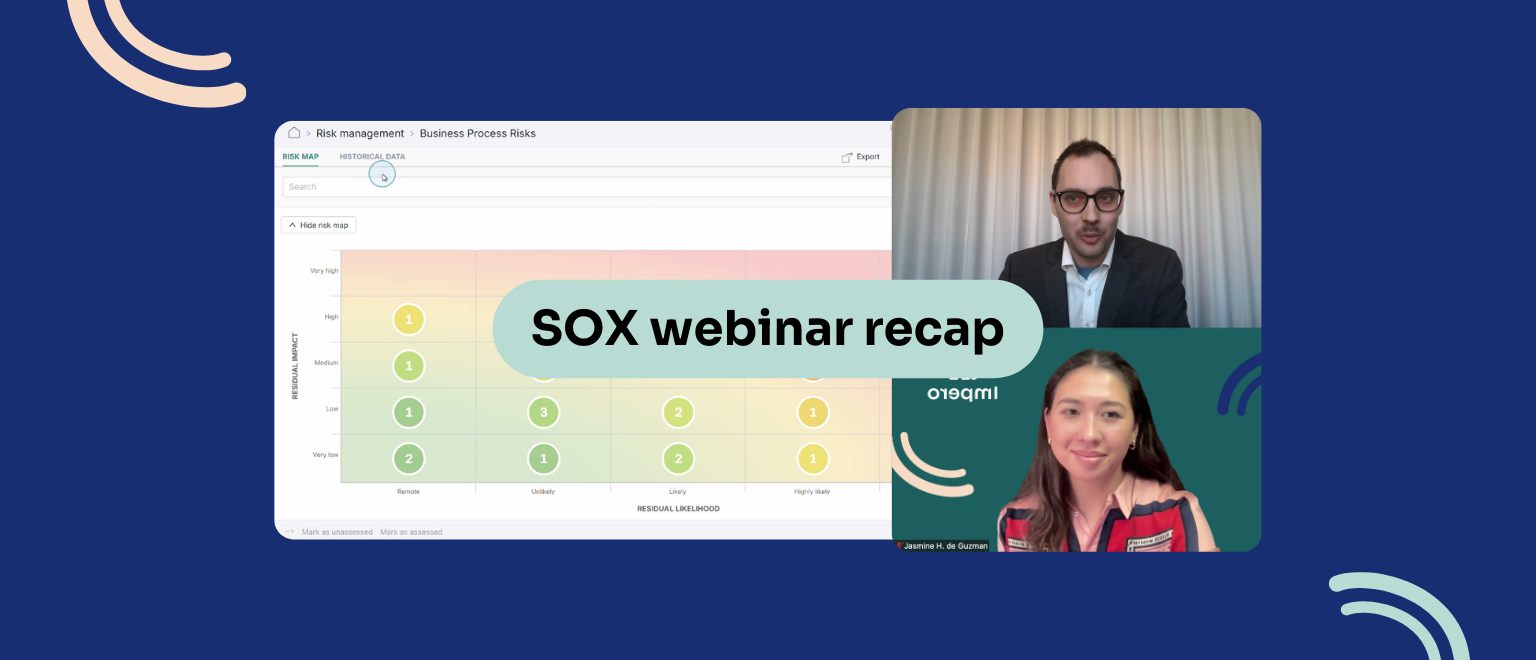
In our recent webinar, “How Impero Simplifies SOX Compliance,” Jasmine H. de Guzman and William Christensen, Implementation Specialist at Impero explored how organizations can move away from fragmented spreadsheets and manual processes toward a more structured, risk-based compliance approach.
Their discussion covered how to manage risks, operationalize controls, document evidence, and maintain continuous audit readiness - all within a centralized governance and compliance framework.
To better understand the audience’s experience with SOX, we also ran a poll during the session. Nearly half of attendees (44%) had already been subject to SOX for more than three years, while another 33% were either about to begin or preparing to start their SOX journey. This mix of maturity levels reflected the range of challenges organizations face when managing compliance programs.
Why SOX compliance often becomes operationally complex
SOX compliance is not just about documenting policies. It requires organizations to design, execute, monitor, and test internal controls that support reliable financial reporting.
In practice, this often means managing:
- Large volumes of recurring control activities
- Multiple reviewers and control owners
- Documentation and evidence requirements
- Continuous reporting and audit preparation
- Control testing by internal or external auditors
Without the right structure, these activities can become fragmented across emails, spreadsheets, and disconnected systems.
This fragmentation increases the risk of:
- Missing control evidence
- Inconsistent documentation
- Limited visibility into control performance
- Time-consuming audit preparation
As William Christensen, Implementation Specialist at Impero noted during the webinar: “For organizations coming from Excel-based systems, you often don’t have the same level of traceability or ownership — and that’s really what SOX is about.”
A more sustainable approach requires connecting risk management, controls, and reporting into a single, traceable workflow.
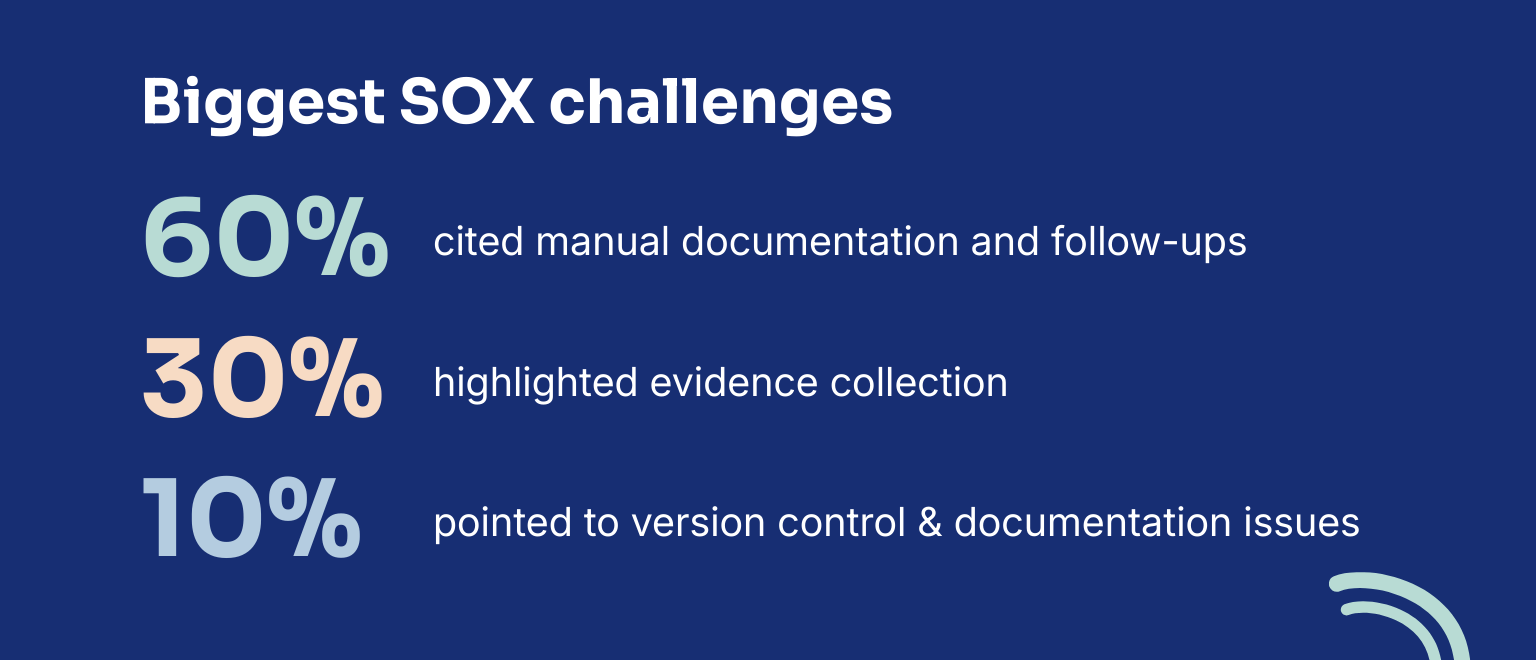
When attendees were asked about their biggest SOX challenges, the results reinforced this point:
- 60% cited manual documentation and follow-ups
- 30% highlighted evidence collection
- 10% pointed to version control and documentation issues
Starting With a Risk-Based Approach to SOX
A key principle discussed in the webinar is the importance of linking controls directly to risk.
A risk-based SOX framework allows organizations to:
- Identify financial process risks
- Map risks to responsible entities, teams, or business units
- Apply mitigating controls to manage those risks
- Track changes in the risk landscape over time
Visual tools such as risk heat maps help compliance teams quickly understand where the greatest exposure exists. They also allow organizations to compare inherent risk with residual risk after controls are applied.
This approach ensures that control programs are not simply checklist exercises, but are actively tied to the risks they are designed to mitigate.
Operationalizing internal controls
Once risks are defined, organizations need a practical way to execute controls consistently.
During the webinar, Impero demonstrated how internal controls can be structured as repeatable workflows, ensuring that control owners know exactly what actions they need to take.
As Christensen explained: “When people come to us, they usually already have some groundwork in place — risks and controls are documented. What we help with is streamlining those controls and making them more effective.”
A well-designed control workflow typically includes:
- Assigned control owners responsible for execution
- One or more reviewers validating the control activity
- Clearly defined tasks and instructions
- Evidence uploads or documentation requirements
- Automated reminders and due dates
Measuring control effectiveness
Executing controls is only part of the compliance process. Organizations must also measure whether those controls are actually working.
In the webinar, the presenters highlighted how control reviewers can assess control effectiveness as part of the workflow. If a control is rated as partially effective or ineffective, remediation actions can be triggered immediately.
This creates a continuous feedback loop where:
- Controls are executed
- Effectiveness is evaluated
- Remediation actions are tracked when needed
Again Christensen summarized: “SOX is really about ensuring accuracy through ownership and continuous improvement.”
Reporting and maintaining audit readiness
Another major challenge in SOX compliance is reporting.
Compliance leaders often need to answer questions such as:
- Which controls have been completed this quarter?
- Which controls are overdue?
- Where are the highest risk areas?
- Which controls were rated ineffective?
Centralized reporting makes this significantly easier. By consolidating compliance activities within a single platform, organizations can quickly generate insights and maintain transparency across teams, stakeholders, and auditors.
Formal control testing for internal audit
Beyond operational control execution, organizations must also test whether controls function as intended.
Internal audit teams typically perform control testing by selecting samples of previously executed control activities and reviewing the underlying evidence.
In the webinar demonstration, this process included:
- Creating structured testing programs
- Selecting samples of control activities
- Reviewing evidence and completion records
- Documenting conclusions about control effectiveness
This creates a full audit trail, providing both internal auditors and external auditors with transparent documentation of how controls operate.
Conclusion
SOX compliance does not have to rely on fragmented documentation and manual tracking.
By connecting risk management, internal controls, reporting, and testing within a single structured environment, organizations can significantly reduce operational complexity while strengthening governance and audit readiness.
For compliance leaders, the goal is not just to pass the next audit, but to create a sustainable internal control environment that supports long-term risk management and regulatory confidence.
As de Guzman noted during the demonstration: “The flexibility of the platform means we can adapt it to your business needs — because every organization approaches compliance a little differently.”
For organizations managing SOX programs today, the challenge is rarely a lack of controls—it is the complexity of coordinating those controls, documenting evidence, and maintaining visibility across teams and processes. A centralized approach to risk, controls, and reporting can help compliance teams streamline these activities while improving transparency and audit readiness.
If you want to dive deeper into the discussion and see how these workflows work in practice, you can watch the full webinar recording here.
Get the latest from Impero in your inbox.
Stay informed on all things Impero — webinar & event invites, exclusive content, product launches, and more! Or let us show you why Impero is the right choice for your risk and compliance needs.

You might also like...
Explore insights, product updates, and practical guidance to navigate the world of risk & internal controls.