


Continuous controls: From concept to capability
Internal controls are well documented in most organizations. Policies exist. Control descriptions are approved. Frameworks are signed off.
What is far less clear is whether those controls are operating effectively at any given point in time.
As business cycles accelerate and risk environments grow more complex, point-in-time assurance no longer reflects how organizations actually operate. Controls that are reviewed annually or tested in samples struggle to keep pace with continuous change.
This is driving a global shift toward continuous controls. Not as a response to a single regulation or geography, but as a recognition that assurance needs to be built into everyday operations, not applied after the fact.
Yet while the concept is gaining momentum, execution often falls short. Many organizations underestimate what continuous controls really require.
This article looks at what continuous controls mean in practice, why initiatives often stall, and what organizations need to get right to turn the concept into a sustainable capability.
Continuous controls are not about real-time dashboards
Continuous controls are frequently described as “real time” or “always on.” While technology plays a critical role, continuity is not defined by speed or frequency alone.
In practice, continuous controls mean that:
- Controls are embedded directly into business processes, not layered on afterward
- Evidence is generated as a byproduct of execution, not collected at year or -period end
- Deviations and exceptions trigger remediation-centric action, not just reporting
The real shift is not from annual to daily testing. It is from retrospective assurance to ongoing confidence.
This is why continuous controls are increasingly being discussed across markets, whether in the context of Tax Compliance Management Systems (TCMS) in Germany, evolving corporate governance expectations in the UK (Provision 29 of the UK Corporate Governance Code), or broader global audit and regulatory scrutiny. The underlying expectation is the same: organizations should know whether their controls are working, without waiting for a formal review cycle.
Why continuous control initiatives often stall
Despite strong intent, many organizations struggle to move beyond pilots. Common challenges include:
Alert fatigue and noise
Automation makes it easy to scale controls. It also makes it easy to scale low value alerts. When every deviation is treated as critical, teams quickly lose focus.
Too many controls, too little insight
Some organizations attempt to make all existing controls continuous. This often results in hundreds of automated checks that add complexity without improving assurance.
Unclear ownership
A control that runs continuously but has no clear owner does not reduce risk. It simply produces unanswered signals.
Fragmented systems and data
Continuous controls depend on consistent, reliable data. When processes span multiple systems with manual handoffs, control effectiveness becomes difficult to prove at scale.
These challenges are not technology failures. They are design and governance failures.
The three pillars continuous controls depend on
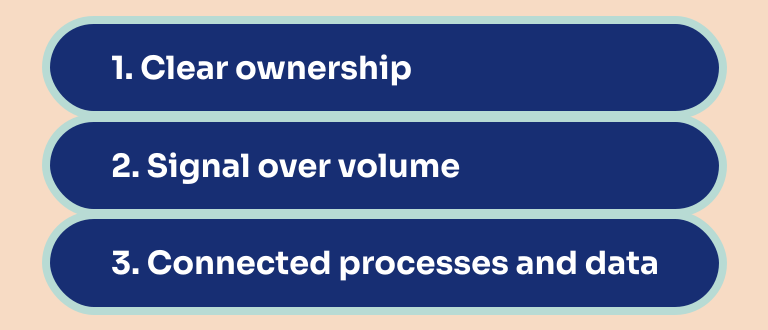
Organizations that succeed with continuous controls tend to focus on three foundational pillars.
1. Clear ownership
Every key control needs a clearly defined owner who is accountable for its operation, alignment with business processes and follow up. When an exception occurs, there must be no ambiguity about who investigates, who decides, and who remediates.
This is especially important as controls become more automated. Automation does not remove accountability. It increases the need for it both within the business and those responsible for the documentation and administration of risk & controls.
2. Signal over volume
Continuous controls work best when they focus on what truly matters.
Rather than automating every possible check, leading organizations identify a smaller set of high impact controls tied to material risks. These controls are designed to prevent or detect issues early, not to document activity.
This principle is increasingly visible in areas like tax, where organizations are moving away from documentation driven frameworks toward automated monitoring of a limited number of critical risk indicators. Beyond that, high impact controls group the needs of business units into a single, well designed control – rather than multiple controls asking for the same data point or evidence.
3. Connected processes and data
Controls lose value when they operate in isolation. To be effective continuously, controls must be connected to the underlying process, the relevant data sources, and the broader risk context.
This is why fragmentation remains one of the biggest barriers to continuous assurance. Without an integrated view, organizations may have activity, but lack insight.
Continuous controls require simplicity by design
One of the most common misconceptions is that continuous controls require more controls.
In reality, continuity amplifies both good and bad design. Poorly defined controls become louder, not better, when automated. Vague control descriptions make testing and monitoring harder, not easier.
Organizations that make progress focus on:
- Clearly defined, testable controls
- Preventive controls where possible, rather than detective ones
- Standardized definitions and taxonomies across functions
This simplification is what enables scalability. Without it, continuous controls quickly become unmanageable. And while technology can provide structure throughout this journey, it is the people and processes behind it that make it successful.
A maturity journey, not a switch
Very few organizations move to continuous controls in one step. The shift typically happens incrementally.
Common starting points include:
- High volume transactional processes
- Areas with recurring audit findings
- Processes with strong system support and data quality
From there, organizations expand gradually, refining control design, ownership, and escalation mechanisms along the way.
This approach reflects a broader change in mindset. Continuous controls are not a destination. They are a capability that matures over time.
From compliance activity to everyday confidence
At their best, continuous controls do not create a sense of constant surveillance. They create trust.
Trust that risks are being managed as the business operates. Trust that issues will surface early. Trust that assurance is grounded in reality, not retrospective documentation.
This is why continuous controls are gaining momentum globally. Not because of one regulation or one market, but because the way organizations operate has changed.
Annual snapshots can no longer keep up. Continuous clarity is becoming the new standard.
Get the latest from Impero in your inbox.
Stay informed on all things Impero — webinar & event invites, exclusive content, product launches, and more! Or let us show you why Impero is the right choice for your risk and compliance needs.

You might also like...
Explore insights, product updates, and practical guidance to navigate the world of risk & internal controls.