




AI + risk & internal controls: opportunity or challenge?
AI is no longer a future discussion for teams working with risk and controls.
It is already influencing how risks are being documented, how controls are designed, and in some cases – it's already influencing how decisions are made.
What makes AI difficult is not a lack of potential, but the fact that it creates two very different compliance realities at the same time. For some organizations, AI is a genuine accelerator. For others, it has become a new source of risk, complexity, and false confidence.
In 2026, the difference between those outcomes matters more than the technology itself.
Why AI is a real opportunity
At its best, AI addresses some of the most persistent challenges in risk, internal control and compliance environments.
Manual testing, spreadsheet-driven evidence, and periodic reviews were never designed for high-volume, fast-moving operations. Automations and AI change that dynamic by enabling:
- Continuous monitoring instead of annual or quarterly testing
- Faster detection of anomalies and deviations
- Automated evidence collection and documentation
- Earlier visibility into emerging issues, not just historical failures
- Better focus on exceptions, rather than routine transactions
This shift allows teams to spend less time proving that controls exist and more time understanding whether they are actually effective (or need attention).
When applied to financial and tax compliance, AI can support more timely oversight, stronger audit readiness, and better decision-making, especially in complex or decentralized organizations.
Why the same AI becomes a challenge
The challenge is that AI does not remove risk. It reshapes it.
Traditional control frameworks were built for predictable systems with stable rules. AI-driven processes are adaptive, probabilistic, and often difficult to explain in simple terms. That creates new pressure points, including:
- Limited transparency into how decisions are made
- Models that change behavior over time without clear visibility
- Increased reliance on data quality that may not be consistent
- Tools being used outside formal governance structures
- A growing gap between automated outputs and human understanding
- Overreliance on AI and technology to flag issues and errors
In some cases, AI introduces a dangerous illusion of control. Processes appear more advanced, but the underlying risks are harder to see and harder to challenge.
This is why AI can feel like progress and risk at the same time.
AI does not fix weak internal control environments
One of the most important realities organizations are discovering is that AI does not compensate for poor foundations.
If controls are unclear, ownership is fragmented, or data is unreliable, AI will not solve those problems. It will simply scale them.
Organizations that struggle most with AI adoption tend to share familiar issues:
- Controls described at a high level, but not clearly testable
- Unclear accountability across finance, tax, risk, GRC IT and other departments
- Inconsistent data across systems and geographies
- And in some cases, still be leveraging manual documentation and processes in Excel
In contrast, organizations that see real value from AI usually start with discipline rather than ambition. They introduce AI where it supports clearly defined controls, known risks, and well-understood processes.
The real shift is from experimentation to governance
The debate is no longer about whether AI should be used. It is about how intentionally it is governed across the business – but especially in compliance- and audit-centric scenarios.
Many organizations are moving away from broad experimentation toward targeted, explainable use cases. Especially in financial and tax compliance, the emphasis is shifting toward AI that can be:
- Straightforward, understood and explained
- Monitored over time
- Evidenced to auditors and regulators
- Integrated into existing control frameworks
- Supported by clear human oversight
This is where AI becomes both a control enabler and a risk object. It supports control execution, but also needs controls of its own.
Treating AI as a governance topic, not just a technology initiative, is becoming essential.
Human judgment still matters
Despite the pace of automation, AI does not replace professional judgment.
What it does change is where human effort is applied. Instead of spending time on repetitive testing and documentation, teams are increasingly focused on interpretation, escalation, and decision-making.
The most effective control environments are not fully automated or fully manual. They are designed to combine machine speed with human expertise, context and validation.
AI can surface patterns, anomalies, and signals. Humans still decide what matters, what to challenge, and what to act on.
Opportunity and challenge are two sides of the same coin
Framing AI as either an opportunity or a challenge oversimplifies reality.
In practice, it is always both.
AI has the potential to strengthen control effectiveness, improve oversight, and reduce manual effort. At the same time, it introduces new forms of risk that require clearer governance, stronger foundations, and more deliberate design.
In 2026, the organizations that succeed will not be the ones that adopt AI the fastest. They will be the ones that adopt it with intent, clarity, and accountability.
AI is not the destination.
It is the pressure test.
AI assisted. Human validated. Always audit-ready.
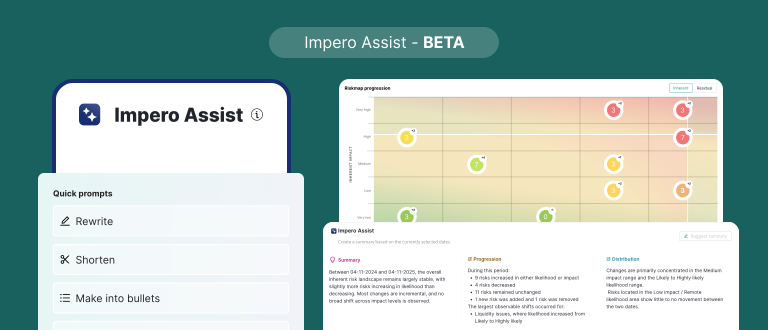
Many platforms in the GRC and tax technology space are pushing an AI-first approach, but at Impero, we’re taking a more deliberate path.
As we’ve shared before during our quarterly Product Update webinars, our philosophy is to apply AI where it genuinely enhances risk and control processes, not to replace the human judgment those processes rely on. AI should support efficiency and insight, but it cannot substitute validation and verification, nor should it ever make governance decisions independently. That’s how we’re prioritizing AI in the Impero platform: as a practical, controlled enhancement—not a wholesale replacement.
This philosophy comes to life with the upcoming launch of Impero Assist – BETA, our new suite of AI-assisted capabilities designed to streamline workflows, reduce manual effort, and surface meaningful insights – all while keeping humans firmly in control. It’s an exciting step forward, giving you a faster, smarter way to work without compromising auditability or governance. Stay tuned and sign up for our newsletter to be the first to know when it becomes available!
Importantly, this approach is built with trust and control at its core. AI features in Impero require explicit admin opt-in, are not trained on your data, and are designed to minimize the risk of data leakage. If you’d like to dive deeper into how we approach AI responsibly, you can read our AI policy to learn more.
Get the latest from Impero in your inbox.
Stay informed on all things Impero — webinar & event invites, exclusive content, product launches, and more! Or let us show you why Impero is the right choice for your risk and compliance needs.

You might also like...
Explore insights, product updates, and practical guidance to navigate the world of risk & internal controls.