


SOX segregation of duties: what it is and why it matters
When organizations begin working with Sarbanes-Oxley (SOX) controls, one principle comes up again and again: segregation of duties.
Interestingly, segregation of duties is never actually mentioned in the text of SOX itself, which says a lot about how fundamentally basic the concept is when it comes to setting up effective internal control over financial reporting (ICoFR).
It sounds simple. Different people should handle different parts of a financial process.
But in practice, this is often where control environments either succeed or fail — and while a lack of segregation may not cause the entire system to fail, it’s one of the most common areas where deficiencies are identified.
Without proper segregation of duties, organizations increase the risk of errors, fraud, and undetected control failures. With it, they create transparency, accountability, and stronger internal controls.
What segregation of duties means in SOX
Segregation of duties (SoD) is a fundamental internal control principle. It ensures that no single person has control over all critical steps of a financial process.
Instead, responsibilities are divided across multiple individuals so that one person performs the task, another reviews or approves it, and a third may reconcile or monitor the activity. This structure creates natural checks and balances within financial processes.
In a SOX environment, SoD typically applies to areas such as:
- Journal entries
- Financial close processes
- Vendor payments
- Access management in financial systems
- Control testing and approval
The goal is straightforward: prevent a single individual from being able to initiate, approve, and conceal a transaction.
Why segregation of duties matters for SOX compliance
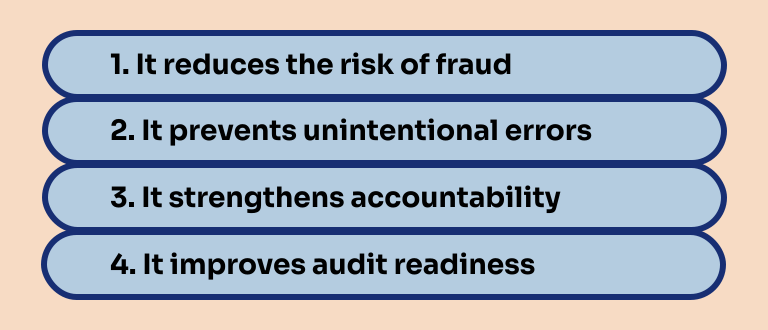
SOX compliance is fundamentally about the reliability of financial reporting, and SoD plays a central role in achieving that reliability.
1. It reduces the risk of fraud
When one person controls multiple stages of a financial process, it becomes much easier to manipulate transactions. If an employee can both create and approve payments, for example, unauthorized transactions may go undetected for months.
By separating these responsibilities, organizations introduce oversight into the process. Fraud becomes significantly harder to execute and much easier to detect.
2. It prevents unintentional errors
Not all control failures stem from malicious intent. Many occur simply because one individual manages too many responsibilities and mistakes slip through without a second set of eyes.
When tasks are separated, reviewers can catch errors before they impact financial reporting. That review layer strengthens the accuracy of financial data and reduces the risk of reporting mistakes.
3. It strengthens accountability
SoD also clarifies ownership. When roles are clearly defined, everyone understands their responsibilities in the control environment. That transparency makes it easier to identify control breakdowns, trace actions back to responsible individuals, and improve processes over time.
Without this structure, responsibilities often become blurred and governance weakens as a result.
4. It improves audit readiness
Auditors frequently focus on SoD when assessing internal controls, and weak segregation is one of the most common findings in SOX audits.
Organizations that clearly document and enforce role separation are better positioned to demonstrate that their controls are operating effectively. That reduces audit friction and builds confidence in the overall control framework.
The challenge: segregation of duties is harder than it sounds
Despite its importance, SoD is often difficult to maintain in practice. Here are the challenges organizations face most frequently:
Limited resources. Smaller teams often don't have enough people to fully separate responsibilities. In these cases, a single employee may end up owning both the execution and the review of a control, which defeats the purpose entirely.
Manual processes. Spreadsheets and email-based workflows make it nearly impossible to enforce role separation consistently. There's no reliable way to verify who did what, or when.
System complexity. Financial systems frequently contain overlapping permissions and access rights that nobody has audited in years. An employee may technically have access to approve transactions they should never touch.
Lack of visibility. Control owners often struggle to see where conflicts exist across processes, especially in larger organizations where responsibilities span multiple teams and systems.
As organizations grow and processes become more complex, maintaining proper SoD requires structure and transparency, not just good intentions.
How to strengthen segregation of duties
Improving SoD doesn't always require hiring additional staff. Often, it starts with better process design and clearer control visibility. Here are 3 areas to focus on.
Define clear control ownership
Every control should have clearly defined roles: who performs the task, who reviews or approves it, and who tests it. Documenting these roles reduces ambiguity and makes it much easier to enforce separation and to spot gaps when they appear.
Review system access regularly
Access rights within financial systems should reflect the organization's actual control structure. Periodic access reviews help identify conflicts where individuals have excessive permissions they no longer need or never should have had.
This is especially important in ERP systems, finance platforms and tax reporting tools, where access rights can quietly accumulate over time.
Centralize control documentation
When controls live in disconnected spreadsheets or email threads, it's difficult to track who is responsible for each step, let alone whether duties are properly separated. Centralizing control documentation creates transparency across the entire control environment and helps ensure SoD is maintained consistently as the organization evolves.
Segregation of duties is the foundation of strong controls
SoD is ultimately about trust and verification. Organizations rely on employees to perform critical financial processes, but strong governance requires mechanisms that ensure those processes are reviewed and validated independently.
When duties are properly segregated, organizations gain stronger financial controls, improved transparency, and greater confidence in their financial reporting. Without it, even well-designed control frameworks can quickly break down.
Supporting SoD with the right tools
As organizations scale, managing SoD manually becomes increasingly difficult. Control owners need visibility into who performs each control, who reviews it, and whether responsibilities overlap, all in one place.
In the Impero platform, organizations can document controls, assign ownership, and track review workflows across the entire control environment. That means duties stay properly segregated, accountability stays clear, and teams spend less time chasing spreadsheets and more time on the work that matters.
If you’re looking to see this in practice, we’ve demonstrated how Impero helps simplify SOX compliance in this webinar — covering everything from control management to segregation of duties. It’s a practical walkthrough of how to move from manual processes to a more structured, scalable approach.
Get the latest from Impero in your inbox.
Stay informed on all things Impero — webinar & event invites, exclusive content, product launches, and more! Or let us show you why Impero is the right choice for your risk and compliance needs.

You might also like...
Explore insights, product updates, and practical guidance to navigate the world of risk & internal controls.